Friday, 20 August 2010

MUMMIES OF THE WORLD EXHIBITION


A previously unseen collection of 150 mummified humans, animals and burial artefacts went on display in the US this month. The Mummies of the World exhibition opened at the California Science Center, Los Angeles, and is being billed as the largest travelling exhibition of mummies ever assembled.

The exhibition sees the largest ever assembly of mummies opened in Los Angeles.

As well as displaying the mummies, which have been donated by museums in Europe, the exhibition highlights the work done using modern scientific techniques to date and analyse the human and animal remains.

"We showcase the current methodology using CT scans, MRIs, X-rays, other types of techniques that allow a scientist to investigate mummies without damaging them and finding out new things about past environments, people and civilizations," says Dr Diane Perlov, senior vice president for exhibits at the California Science Centre.

The concept of the exhibition started in Germany in 2004, with the re-discovery of 20 specimens within the Reiss-Engelhorn Museums of Mannheim.

The project grew when 21 museums around Europe agreed to loan specimens for the collection.

"As a condition of the loan, they're all going be analysed, which is wonderful," says Dr Perlov.

Before being returned to their home museums, the mummies will all be examined using DNA analysis, radiocarbon dating, mass spectrometry and other techniques.

Last week one of the specimens, the remains of Michael Orlovits, who was born in 1765 and was discovered in a church crypt in Hungary, in 1994, had a CT scan at the well-known Cedars Sinai medical centre in Los Angeles.

The hospital donated its experts and equipment for the project. The mummy was among a group of specimens preserved by the cool, dry air of the crypt and the oil from the pine boards used to build their coffins.

Using DNA analysis, researchers discovered that Michael's wife, who was also in the crypt, had suffered from severe tuberculosis.

Information gleaned from present day scientific analysis of mummies is also assisting medical research.

"Mummies are not just pieces of the past - they're actually an insight into the future as well," explains Dr Heather Gill-Frerking, the scientific research curator for the German Mummy Project.

"By studying things like the DNA, by studying the development of disease, by studying the progress of movement within populations, we get a sense of where we're going in the future, not just where we've been."

In particular, the researchers hope to shed light on the complex history of tuberculosis through the analysis of mummies.

"We're able to explore tuberculosis in several ancient populations, and so by studying the pathogen DNA over time, we've been able to look at how the strain has developed," says Dr Gill Frerking.

Now with the resurgence of tuberculosis and drug resistant tuberculosis in modern populations, we can trace the evolution of the disease and perhaps find better ways to treat it."

'Into the afterlife'
Mummification is a rare phenomenon, since it requires the preservation of soft tissue, such as skin, muscle or organs.

Naturally occurring mummies are found in bogs, ice or desert environments. Some cultures deliberately mummify bodies for long term preservation.

"The ancient Egyptians had a very strong belief about the afterlife and making sure that the body was intact going into the afterlife," says Dr Gill Frerking.

"The South Americans were very much ancestor worshippers so in some cultures it was important to keep family members intact for either discussion and decision-making or perhaps being part of family feast days.

"Mummies have fascinated people for a long time," says Dr Perlov.

"There is something about why is it that these mummies have survived and not decomposed. Also, the fact that they're human, we kind of see ourselves in them."

CHOI & SHINE ARCHITECTS


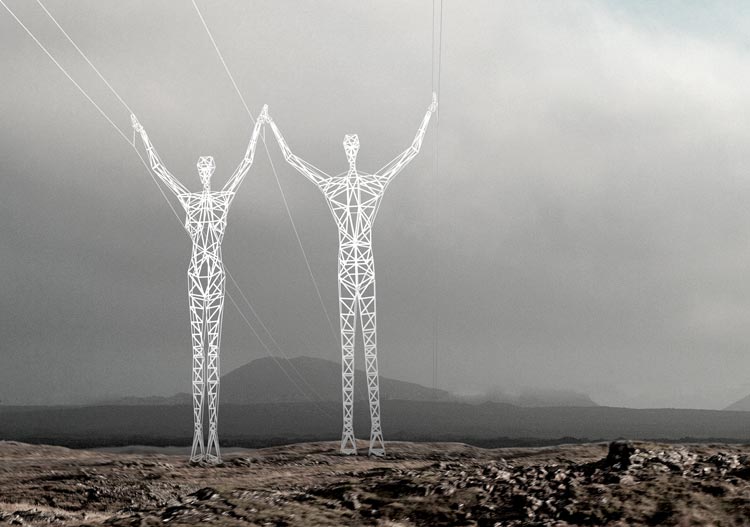
This post is not that relevant to my research (or is it? - I suppose this could be classed as "Land Art"?) but felt I had to post it on here. It is great to see that some countries can incorporate great design into the most mundane of necessary objects. The Architects Choi & Shine must be congratulated for there vision in making the common electricity pylon a thing of beauty - "Land of Giants".

Making only minor alterations to well established steel-framed tower design, we have created a series of towers that are powerful, solemn and variable. These iconic pylon-figures will become monuments in the landscape. Seeing the pylon-figures will become an unforgettable experience, elevating the towers to something more than merely a functional design of necessity.

The pylon-figures can be configured to respond to their environment with appropriate gestures. As the carried electrical lines ascend a hill, the pylon-figures change posture, imitating a climbing person. Over long spans, the pylon-figure stretches to gain increased height, crouches for increased strength or strains under the weight of the wires.

The pylon-figures can also be arranged to create a sense of place through deliberate expression. Subtle alterations in the hands and head combined with repositioning of the main body parts in the x, y and z-axis, allow for a rich variety of expressions. The pylon-figures can be placed in pairs, walking in the same direction or opposite directions, glancing at each other as they pass by or kneeling respectively, head bowed at a town.

Despite the large number of possible forms, each pylon-figure is made from the same major assembled parts (torso, fore arm, upper leg, hand etc.) and uses a library of pre-assembled joints between these parts to create the pylon-figures’ appearance. This design allows for many variations in form and height while the pylon-figures’ cost is kept low through identical production, simple assembly and construction.

Like the statues of Easter Island, it is envisioned that these one hundred and fifty foot tall, modern caryatids will take on a quiet authority, belonging to their landscape yet serving the people, silently transporting electricity across all terrain, day and night, sunshine or snow.

“These designs were submitted as a competition entry in March of 2008 to Landsnet, Iceland national power transmission company who was working in collaboration with the Association of Icelandic Architects. The competition’s goal was to obtain new ideas in types and appearances for 220kV high-voltage towers and lines. The competition emphasized that specific consideration be given to the visual impact of the towers (or lines) and that careful consideration be given to the appearance of towers near urban areas and unsettled regions.

“The competitors were free to choose whether all the towers would have a new look, particular towers and selected environments would have a new look, or whether the appearance of known types of towers would be altered. In addition, it was left up to the competitors whether the design would blend into the landscape in rural and urban areas, or the tower/towers would stand out as objects.

“The main goal of the competition was that a new type of tower/towers would emerge, altering the overall appearance of line routes and that towers could be developed further with respect to environmental impact, the electromagnetic field lifetime and cost.

“The competition was advertised in Iceland and abroad.
-adapted from the selection committee’s competition report, 2008

Thursday, 19 August 2010

DECAYING CARS


Danny dropped me a link to some images of cars that are decaying naturally and with help from us.

They are really nice images and have decided to put them on the blog as a reference point if I need them when finalising the report.

The car which is being eaten up by the undergrowrth is taken by a photographer called Mark Steinmetz. The image of the car in the dessert is by an unknown photographer.

KUDZU COVERED HOUSES


This abandoned cabin near Dahlonega, Ga. is shown in all four seasons of 2001. In late fall immediately after the first frost or freeze the kudzu leaves turn brown and begin to fall from the vine.

CADILLAC RANCH


Over the decades, a lucky handful of offbeat attractions have grown in recognition and stature, celebrated frequently in magazine photo essays, in calendars, as backdrops for music videos and movies. These Great Monuments are rhapsodized as the embodiment of American hopes and dreams, folly and failure, art and commerce, materialism and spiritualism. Professional authors and screenwriters know a pre-baked, easy-to-get symbol when they see it. Who are we to buck the trend?

The Cadillac Ranch, located along the tatters of historic Route 66, was built in 1974, brainchild of Stanley Marsh 3, the helium millionaire who owns the dusty wheat field where it stands. Marsh and The Ant Farm, a San Francisco art collective, assembled used Cadillacs representing the "Golden Age" of American Automobiles (1949 through 1963). The ten graffiti-covered cars are half-buried, nose-down, facing west "at the same angle as the Cheops' pyramids."

In 1997, development creep forced Marsh to move the entire assemblage about two miles further west. The line of cars is far enough out in a field to allow for suitably bleak photography. The distance from any authority also encourages ever-mutating layers of painted graffiti, which Marsh doesn't seem to mind.

Visitors are encouraged 24/7 - just don't steal any of Stanley's colorful signs. The 62-year old Marsh has had a few interesting run-ins with the law over his brand of enforcement. In 1994, he was accused of threatening an 18-year old with a hammer and penning him inside a chicken coop. He's been sued by a family claiming Marsh tricks teens into working for him after catching them red-handed with one of his signs.

Sounds like Marsh is just adding an unexpected thrill around a ranch visit, but then we didn't try to steal a sign. In 2005, the Cadillacs were painted pink in a tribute to breast cancer victims. Since visitors are encouraged to add their own graffiti, this look probably won't endure...

Other bits of Marsh art can be found in the vicinity. There is a pair of legs between Amarillo and Canyon, Texas.

The Cadillac Ranch influenced subsequent artistic works wrought in Detroit metal. Witness Alliance, NE's over-the-top Carhenge and Berwyn, IL's Cars-on-a-Spike.

SYLVAIN MEYER


Land-Artist Sylvain Meyer uses what's available on site to create these beautiful land art or landscape art. Its his patience and keen observation that he collects the elements around to create these gorgeous artwork.

NOEMIE GOULDAL


Noemie recreates small episodes from people's lives. Some are based on their fantasies and others draw on their personal experiences. But what is common to all her work is Noemie's ability to translate these anecdotes into a visual language using the narrative properties of the photograph to convey more than a literal document.

Noemie began taking pictures as a young teenager in her grandmother's garden, where she would ask her sisters to dress up in costumes and play a role for the camera. She went on to study graphic design at college but when reviewing her final portfolio she realised that it was full of photography and stopped pursing a career as a designer and applied to St Martin's College in London to study photography.

Her talent was quickly recognised when she won the photography prize at Central St Martins, the D&D Student of the Year Award in 2006 and also in the same year being awarded a merit in the Fujifilm competition.

She has been exhibited internationally: her series of Louis Vuitton sponsored Christmas window displays in Hong Kong; at the D & D New Blood show in London, 2007 and her series "Les Roses de Veules" in France.

Her work is regularly published in magazines such as the Telegraph Magazine, Guardian Weekend Magazine, Vogue and Creative Review.

I am drawn to some of Noemie's work and enjoy how she creates feeling from almost room set type shots outdoors. I particulalry like the Waterfall look from lengths of clear plastic.

Noemie says of her work, "During the past years, my practice has predominantly focus on the construction of spaces that enable 'new perspectives' within the photographic framework. I recently worked on images that explore the invasion of man-made elements into organic landscapes introducing the passionate relationship that societies maintain with the world they live in, their desperate need of exploration and possession. The objects of my images are given alternative uses; like frail vestiges remaining after the passage of passionate societies, both organic and man made inevitably remarry and rebuild new lands..."